all
Debugging Incident Response Root Cause

DevOps Troubleshooting

Resolve critical production issues, identify the real failure path, and stabilise systems without guesswork, unnecessary rewrites, or recurring emergency fixes.

Overview

When production fail, most teams do not need more dashboards, more meetings, or more theories on a list of possible causes.

They need the failure understood, isolated, and fixed.

Production issues become expensive quickly. What begins as a technical problem turns into:

  • lost transactions and revenue
  • delayed releases and customer commitments
  • customer complaints and damaged trust
  • team burnout
  • temporary fixes that make the next incident harder to diagnose

We investigate and resolve high-impact infrastructure, application-delivery, and production reliability problems at root-cause level.

We trace the actual failure path across applications, infrastructure, databases, networks, Kubernetes, CI/CD, and external dependencies.

Then we apply the smallest effective change that restores stability without introducing unnecessary complexity.

The objective is clear: restore the service, explain why it failed, and reduce the likelihood of the same failure returning.
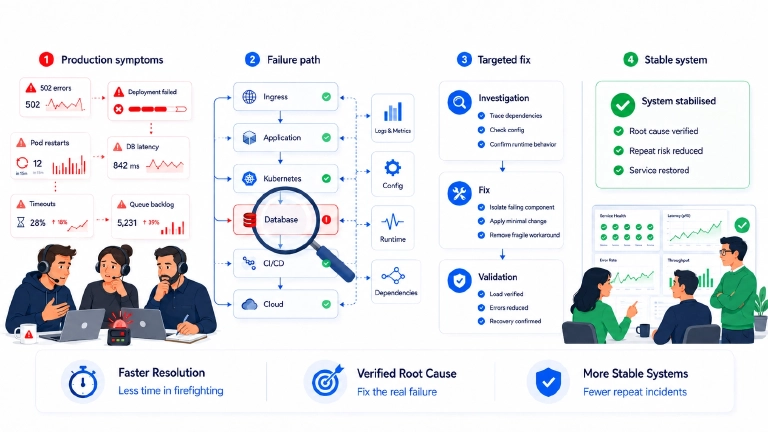
Troubleshooting illustration

Related topics

devops troubleshootingfix production issuesincident response devopsproduction debuggingroot cause analysis

Deliverables

  • Incident analysis
  • Fix implementation
  • Prevention strategy

Outcomes

  • Faster incident resolution
  • Root cause fixes
  • Reduced downtime

What this service is for

This service is designed for situations where the cost of continued investigation is becoming comparable to—or greater than—the cost of the incident itself.

  • production is unstable or partially degraded
  • the same issue keeps returning under slightly different symptoms
  • incidents take too long to diagnose
  • several teams are investigating different parts of the same failure
  • engineers are firefighting instead of delivering planned work
  • senior engineers are repeatedly pulled into first-line investigation
  • internal engineers are blocked by limited time, incomplete telemetry, or missing specialised expertise

This is especially relevant when failures affect:

  • customer-facing web and mobile applications
  • transaction, payment, ordering, or delivery workflows
  • deployment and release reliability
  • Kubernetes workloads and controllers
  • databases under production load
  • queues, workers, and asynchronous processing
  • CI/CD pipelines and release flow
  • shared services used by several applications or customers

What gets fixed

  • recurring production incidents
  • intermittent failures that disappear before investigation
  • systems that recover after restart but fail again later
  • unstable deployments and incomplete rollouts
  • failed, slow, or unreliable CI/CD pipelines
  • infrastructure drift and conflicting configuration
  • database bottlenecks, lock contention, connection exhaustion, and replication issues
  • performance degradation with no clear explanation
  • systems that “work until load increases”
  • temporary fixes that became permanent

Typical problem areas

  • Kubernetes instability
  • rollout failures and broken deployments
  • infrastructure drift and hidden configuration changes
  • cloud networking and connectivity issues
  • CI/CD failures blocking releases
  • database bottlenecks affecting production
  • resource contention, scaling failures, and noisy-neighbor effects
  • monitoring noise hiding the real incident

When this is a high-value service

This service creates the most value when:

  • the incident is already affecting revenue or customers
  • releases or contractual delivery are blocked
  • several engineers are investigating without convergence
  • previous fixes have only changed the symptoms
  • the issue occurs intermittently and is difficult to reproduce
  • senior engineers are overloaded
  • infrastructure has grown faster than its operational documentation
  • production behaviour differs from test environments
  • the team lacks the time or specialised experience for controlled root-cause analysis
  • continued trial and error creates unacceptable business risk

In these situations, speed alone is not enough.

The investigation must be fast and precise enough to avoid creating the next incident while fixing the current one.

Outcome

The issue is understood, isolated, and corrected.

The system becomes stable enough for the team to return to planned work.

The investigation leaves behind evidence, repeatable procedures, and a clearer understanding of the system.

The same failure becomes less likely to return—and easier to handle if it does.

The team stops repeating the same firefight.

No rituals. No guesswork. Just a working system.

What you get

A verified root cause

  • structured reconstruction of the actual failure path
  • separation of primary failure from secondary symptoms
  • dependency analysis across infrastructure, services, and delivery flow
  • validation based on logs, metrics, traces, events, configuration, deployment history, and runtime behaviour
  • hypotheses tested against evidence rather than accepted because they appear plausible

Fast, targeted remediation

  • minimal changes with highest impact first
  • fixes that stabilize the system before broader cleanup
  • no unnecessary rewrites or “platform transformation”

Reduced repeat incidents

  • the highest-impact and lowest-risk remediation applied first
  • the underlying failure mode is addressed
  • high-risk weak points are identified and reduced

Clear technical conclusions

  • what failed
  • why it failed
  • what was changed
  • what still needs attention

How it is done

  • define the actual problem and business impact
  • reproduce or isolate the issue where possible
  • inspect logs, metrics, events, configuration, deployment flow, and dependencies
  • test hypotheses against real behavior
  • apply the smallest fix that removes the real cause
  • verify the result under realistic conditions

No blind changes. No “restart and hope”. No extra complexity introduced during the fix.

Results

  • production incidents resolved faster
  • fewer repeat failures
  • lower MTTR
  • reduced operational stress
  • more predictable infrastructure behavior
  • less time wasted on workaround cycles

Engagement format

This service can be delivered as:

  • Urgent production troubleshooting: Focused assistance during an active incident or severe degradation.
  • Root-cause analysis: Evidence-based investigation of a recurring, intermittent, or unresolved failure.
  • Production stabilisation: A bounded effort to remove the highest-risk failure modes and restore predictable operation.
  • Post-incident remediation: Correction of temporary fixes, missing safeguards, and operational weaknesses discovered during an incident.
  • Troubleshooting audit: Review of recurring failures, investigation practices, visibility gaps, and unresolved technical risks.
  • Embedded technical investigation: Direct collaboration with the existing engineering team where several systems, vendors, or technical domains are involved.

Scope depends on urgency, system complexity, available evidence, and the current level of production access.

Request initial assessment

Tell us what hurts. We’ll fix the root cause.

  • 24–48h initial response
  • one page action plan
  • measurable outcome targets

No marketing spam. Real solutions, not rituals.